
Acoustic Louvres: The Unsung Heroes of Architectural Noise Control
Acoustic Louvres: The Unsung Heroes of Architectural Noise Control
Modern building design is a constant negotiation.
You have the architectural vision. It demands clean lines and aesthetic purity. Then you have the mechanical reality. A functional building is basically a large machine. It needs to breathe.
This creates a conflict.
The equipment that keeps a building alive is loud. Generators roar. Chillers hum. Fans vibrate.
You need to move massive volumes of air to keep these systems running. But you cannot let noise escape to the street or disturb people living their lives inside.
This is where the acoustic louvre does the heavy lifting. It sits right at the intersection of form and function. It solves the problem of how to silence a building without choking it.
The Physics of the Blade
To the casual observer an acoustic louvre looks like a standard ventilation grille. It is just metal slats on a wall.
But the engineering inside is distinct.
Standard weather louvres are simple. They just keep the rain out. Acoustic louvres are energy traps. We design ours to function as a complete acoustic system using three critical components:
- Aerofoil Blade Profile: The geometry physically blocks the line of sight. Sound waves cannot travel in a straight line through the opening. They are forced to navigate a “tortuous path” around the blades.
- Perforated Underside: The casing is solid metal on top to shed water, but the bottom face is perforated to absorb the unwanted noise.
- Acoustic Infill: Inside the blade is the secret weapon. We pack it with high-density, inert mineral wool or fibreglass to absorb acoustic energy.
The Aerodynamic Balancing Act
Here is the headache for every MEP engineer.
You can make a louvre that blocks 100% of the noise. You just make the wall solid. But then air cannot move.
In ventilation design the enemy is “pressure drop.” Every obstacle you put in the airstream makes the fans work harder. If the resistance is too high the equipment overheats. Or the fans ramp up to compensate.
That just creates more noise and burns more energy.
High-performance louvres have to thread the needle. We focus on optimizing specific aerodynamic metrics to ensure the system works:
- Static Pressure Drop (Pa): Keeping resistance low to minimize fan load.
- Face Velocity: Managing the speed of air at the intake to prevent turbulence.
- Regenerated Noise: Ensuring the air passing over the blades doesn’t create new noise.
- Water Ingress Protection: Balancing air entry with weather protection.
The aerofoil shape smooths the airflow. It keeps the air moving efficiently while the mass of the blade kills the noise.
It’s more than just for looks.
Where We Use Them
You’ll find these units wherever the building envelope is breached for airflow.
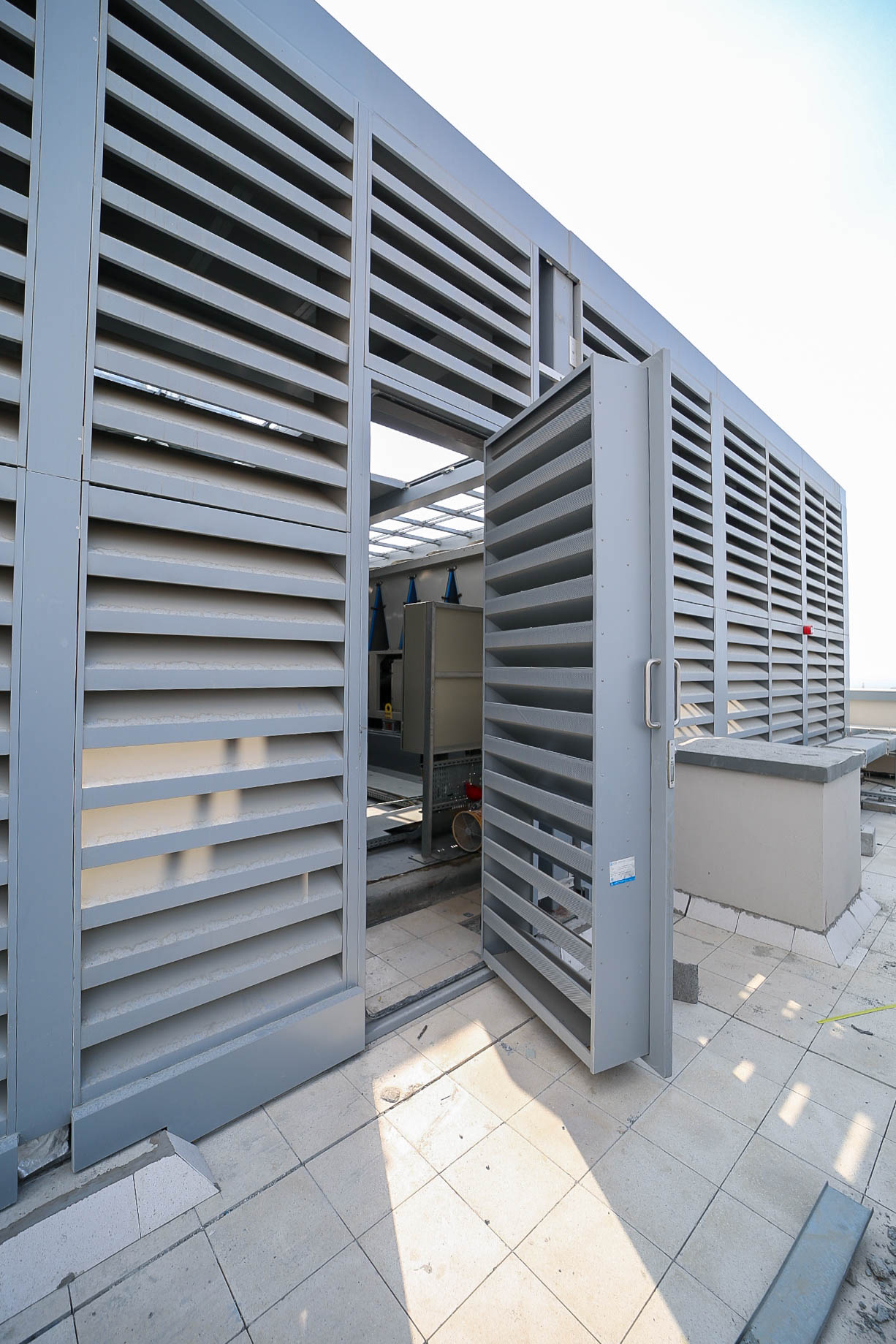
They are critical for building façades. Architects use them to mask fresh air intakes. They need to blend in visually while doing the acoustic work.
They are the standard solution for HVAC plant rooms. These rooms are noisy environments. The louvres serve as the intake walls to contain that mechanical roar.
Go up to the roof and you see them around chillers and cooling towers. Rooftop noise travels. It hits adjacent buildings. Acoustic louvres form screen walls here to block the direct path of the sound without recirculating hot air.
We also see them in industrial ventilation systems. Power generation and manufacturing plants move incredible amounts of air. They rely on louvres like these to keep environmental noise to a minimum.
The Galloway Standard
Specification integrity is the biggest risk in this market.
Not all metal louvres are created equal. If you specify a product based on generic data you are rolling the dice. “Cookie-cutter” specs often fail once the equipment turns on.
At Galloway Acoustics we approach this differently.
Take our L-AS (Single Bank) and L-AD (Double Bank) series. We build them for longevity and verify them for performance:
- Material Construction: Available in heavy-duty galvanized steel (DX51D+Z275) or marine-grade aluminum for corrosive environments.
- Independent Testing: Our performance data is derived from tests in strict accordance with BS EN ISO 10140-2-2021.
- Structural Integrity: Engineered to withstand significant wind loads and environmental stress.
For an acoustic consultant this traceability is non-negotiable. You need to know that the transmission loss data is real. If the lab data is wrong your environmental noise model is wrong. That leads to complaints and expensive retrofits.
The Bottom Line
We rarely celebrate the components we cannot see. That is the nature of the job.
But the acoustic louvre is critical. It allows buildings to function. It keeps the mechanical heart of the structure beating without disturbing the peace.
It comes down to trust. You need a product that balances aerodynamics with acoustics. You need data you can rely on.
Do that right and the building functions as beautifully as it looks.
Contact the Galloway Acoustics engineering team today to discuss your next project requirements and get a custom specification for your build.