Categories
Blog

Custom Acoustic Solutions for the GCC: Mastering Silence in Extreme Climates

Building in the Middle East is different.

You aren’t just fighting physics. You are fighting the environment.

In Europe or North America acoustic design is mostly about mass and geometry. In the GCC you have to add a third variable: extreme heat.

When the ambient temperature hits 50°C standard rules don’t apply. Materials expand. Equipment derates. Sand gets into everything.

Yet the demand for silence is higher than ever. From the luxury hotels of Dubai to the data centres of Riyadh clients demand world-class acoustic performance. They want the cooling but they don’t want the noise.

At Galloway Acoustics we understand this balance. We don’t just import solutions. We engineer them for the region.

The Climate Challenge: Sand, Salt, and Heat

The environment here is hostile to metal.

Coastal humidity eats standard steel. Sandstorms scour painted surfaces. The intense UV radiation breaks down seals.

If you install a standard acoustic enclosure in this climate it won’t last. It will corrode and the acoustic integrity will fail with the structure.

We start with the materials.

  • Substrate Selection: We utilize high-grade galvanized steel and marine-grade aluminum for coastal projects. 
  • Protection: We apply specialized anti-corrosive powder coatings that can withstand the thermal shock and abrasion of the desert environment.

This is about longevity as much as visual appeal. An acoustic screen is useless if the fixings rust out after two summers.

High-quality materials solve that problem entirely.

Taming the Generators

In the GCC backup power is critical infrastructure.

When the grid fluctuates massive diesel generators kick in. The noise is immediate and deafening.

Containing this sound without overheating the engine is a massive engineering challenge. You are essentially running a fire inside a metal box in the middle of a desert.

We solve this with custom acoustic enclosures.

These are precision-engineered systems. We calculate the required airflow to keep the engine within its operating temperature. Then we design the intake and exhaust attenuation to handle that volume.

We pair these with heavy-duty acoustic doors. These aren’t just barriers. They feature high-compression seals to ensure no noise leaks at the threshold. They give you the access you need without breaking the acoustic seal.

Silencing Rooftop Roar

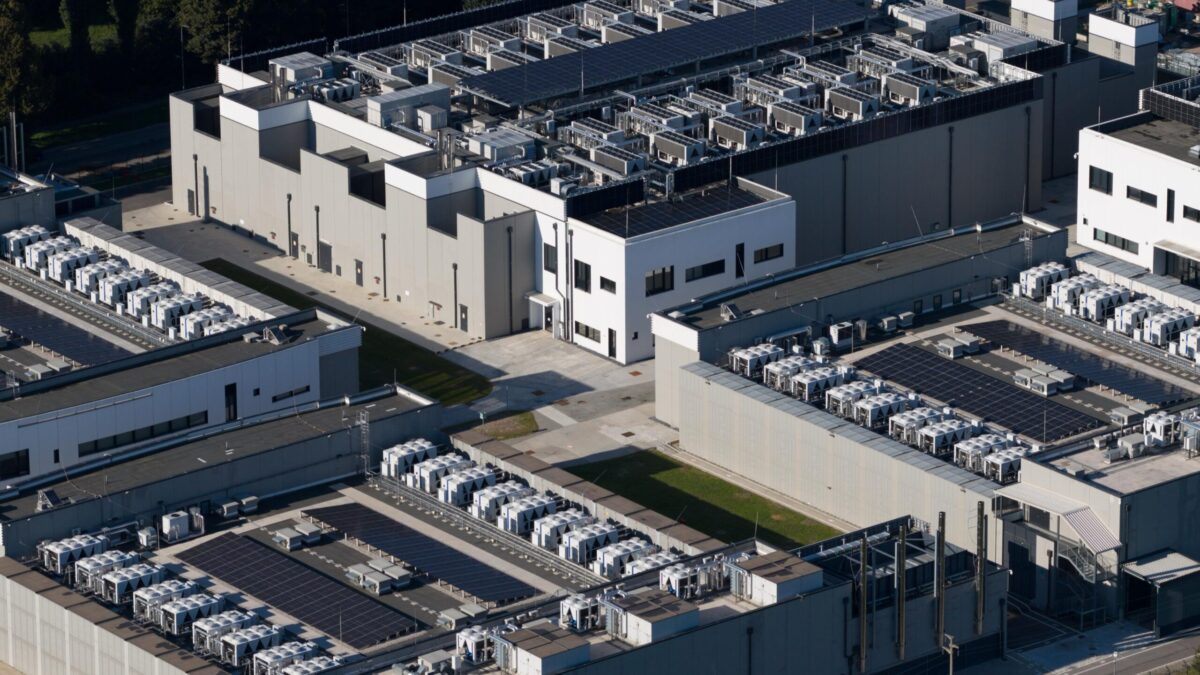
Look at the roof of any mall or skyscraper in the region. It is a sea of chillers.

The cooling load required to keep these buildings habitable is immense. That means the chillers are running hard 24/7.

This creates a constant low-frequency drone that can ruin the environment for nearby luxury apartments or hotels.

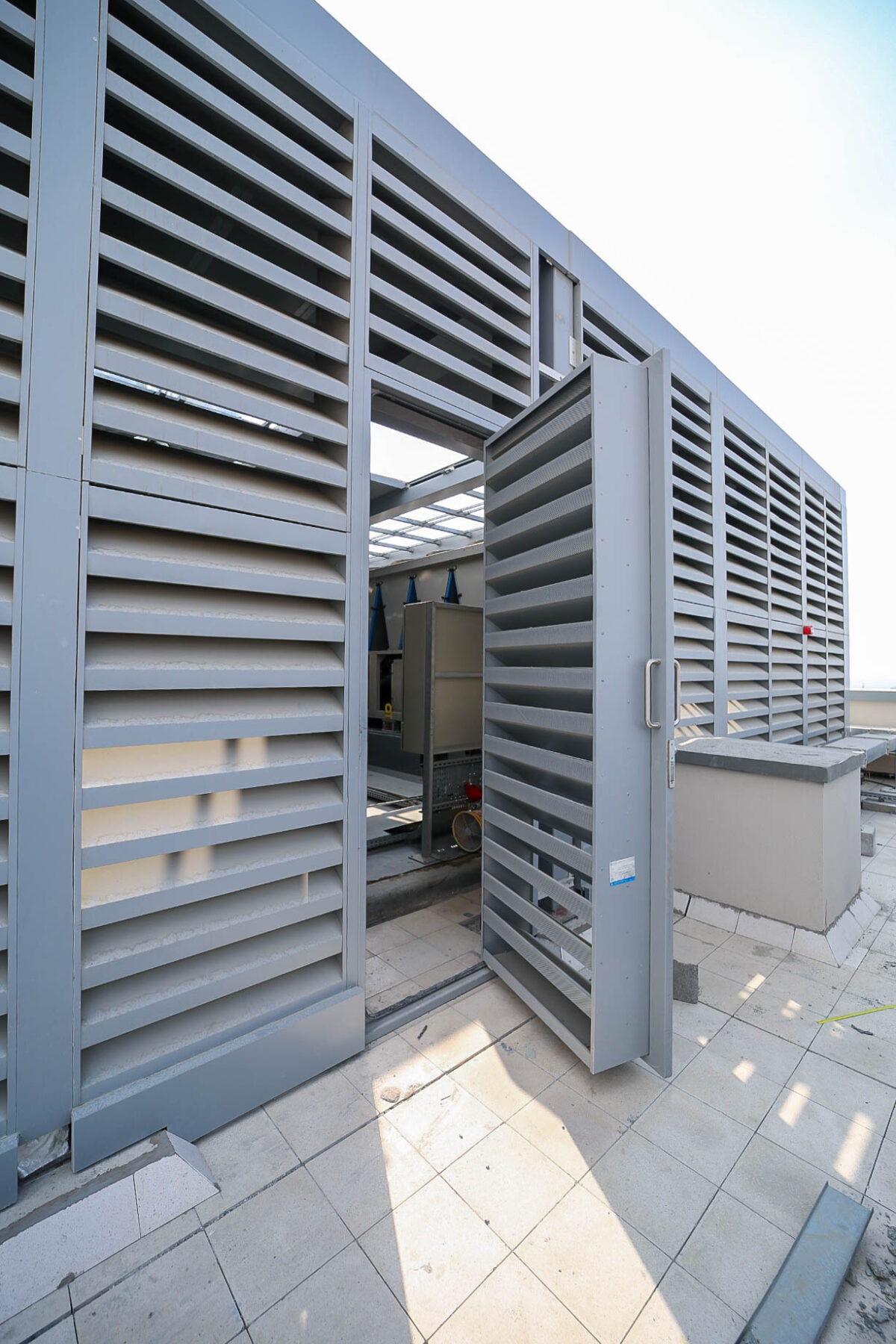
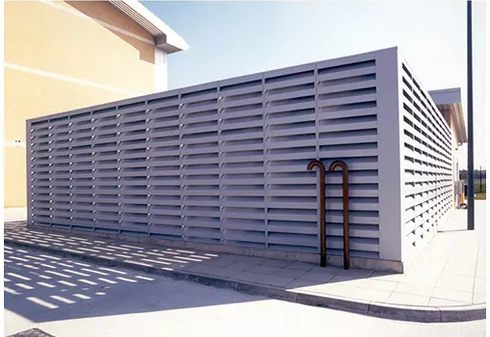
The solution is the acoustic screen.

We build these screens to create a “noise shadow.” We model the line of sight from the equipment to the nearest sensitive receiver. We build the barrier high enough to block the direct path of the sound.

The inner face is absorptive to stop reverberation. The outer face is durable to survive the sun.

The Data Centre Boom

The region is rapidly becoming a hub for Hyperscale and Edge data centres.

These facilities push air at incredible velocities. The servers need a constant clean airflow.

This requires sound attenuators that can handle high velocity without creating turbulence. We aerodynamically profile the splitters to minimize pressure drop. This keeps the PUE (Power Usage Effectiveness) low which is vital for green building standards.

We also deploy acoustic louvres on the façade. These have a dual job. They block the noise from escaping the plant rooms. But they also act as the first line of defense against the elements protecting the sensitive server halls from sand and debris.

Tested for the Real World

In high-stakes projects you cannot rely on guesswork.

If a consultant specifies a noise criterion of NR35 inside an office you need to hit it.

That is why we stick to international standards.

We test our products to BS EN ISO 140-3 and ISO 7235. We don’t just test for sound. We test for airflow.

Simply put, our data holds up whether the project is in London or Jeddah.

The Galloway Advantage

Galloway Acoustics has been operating in this region long enough to know what works.

We know that you cannot fight the climate. You have to engineer for it.

Our team delivers solutions that silence the noise without preventing the cooling. We build systems that last and keep the future in mind.

Contact the Galloway Acoustics engineering team today. Let’s discuss how we can elevate the acoustic performance of your next project in the Middle East.


Categories
Blog

Certified Performance: Why Third-Party Testing is the Only Data That Counts

certified performance galloway acoustics uae

Imagine the scenario: the building is finished. The tenants are moving in. The acoustic consultant arrives for the final commissioning test.

They turn on the chillers. The meter creates a reading. And it is 5dB too high.

Panic sets in.

Retrofitting a live building is a financial disaster. It destroys margins and ruins reputations. You have to tear down walls or replace heavy equipment on a finished roof.

Often the culprit isn’t the design. It is the product data.

If the datasheet says a louvre blocks 15dB but it only blocks 10dB on site you have a serious problem.

This is why third-party testing isn’t just a “nice to have.” It is your insurance policy.

The Risk of Not Knowing

In the acoustic market anyone can print a datasheet.

Some manufacturers rely on “theoretical calculations.” They use software to guess how a product might perform. Or they extrapolate data from a different product and assume it applies.

But sound is tricky. It behaves in unpredictable ways.

Acoustic flanking is a prime example. This happens when sound travels around a barrier or through weak points in the construction. If a product hasn’t been physically tested in a lab you are gambling with your project.

If you fail the noise survey the local authority won’t care about your theoretical calculations. They will just demand you fix it. The legal and financial risk sits with you.

The Rules of the Game

Real testing follows strict rules. You cannot just hold a microphone up to a fan.

Take duct silencers. We test our sound attenuators to BS EN ISO 7235.

This isn’t a static test. We put the attenuator in a calibrated rig. We blast air through it at high velocity. We measure the dynamic insertion loss.

This tells us how much noise the silencer stops while the air is actually moving. That matters because airflow generates its own noise. A static test won’t tell you that.

For acoustic doors we use BS EN ISO 10140.

This measures the transmission loss through the entire door assembly. Not just the steel panel. We test the frame. The seals. The hinges. If you don’t test the assembly you aren’t testing the door.

Why Independent Testing Matters

Self-certification is like marking your own homework.

You need a neutral referee. In the UK and Europe that is UKAS (United Kingdom Accreditation Service).

When we say a product is “independently tested” we mean a UKAS-accredited lab did the work. They don’t care if we pass or fail. They just report the numbers.

This gives you certainty.

When you specify a Galloway Acoustic louvre or enclosure you know the decibel reduction on the sheet is the decibel reduction you get on the building.

Moving the Air Effectively

Acoustics is only half the battle. You also need to move air.

A silencer that kills noise but blocks airflow is dangerous. It creates a massive pressure drop.

This forces fans to work harder to push the air through. It burns energy. It strains the motor. In extreme cases it can damage the HVAC equipment.

Our testing verifies the aerodynamic performance too. We measure the resistance in Pascals (Pa) across the operating range.

This allows MEP engineers to size their fans correctly. No guessing. No overheating.

The Galloway Advantage

We build acoustic screens and enclosures for critical environments. Data centres. Hospitals. Power plants.

There is no room for error here.

That is why we prioritize third-party testing. We spend the money on the labs so you don’t have to spend money on retrofits.

We give engineers peace of mind. You can trust the data. You can trust the design.

Contact the Galloway Acoustics team today to ensure your next project is built on verified, certified performance.

Categories
Blog

From Hospitals to Classrooms: Creating Healthier Spaces Through Acoustic Design

When you enter a hospital or a school, you don’t ever think about the impact that sound creates. It is an invisible force that shapes your overall experience when you are at a premise. 

Excessive noise in classrooms can disrupt learning experiences. Similarly, it can disrupt procedures at a healthcare facility too. This is where acoustic engineering comes into play. Through proper acoustic design, it is possible to protect both patient health and student success. Read on and let’s explore more about it.

Healing Environments: Why Hospital Noise Matters

Hospitals should be quiet sanctuaries for recovery. Yet studies reveal a troubling reality. The average hospital room measures  45 decibels over 24 hours. 

It is more than the 30-decibel level recommended by the World Health Organization. This noise pollution comes from corridor chatter, medical equipment, and other patients sharing rooms.

The health impacts are serious. Noise triggers the release of stress hormones that raise heart rates and blood pressure. Patients exposed to continuous noise experience disrupted sleep cycles, with 86% reporting poor sleep quality. 

Poor sleep slows healing, increases pain perception, and can extend hospital stays. Research shows that noise even elevates cholesterol levels and increases stroke risk over time.

Acoustic Doors provide a vital defense. They create privacy barriers around patient wards while containing noise from busy corridors and noisy plant rooms. 

These specialized doors block sound transmission, allowing patients to rest without constant disturbance. In sensitive areas like intensive care units and recovery rooms, proper door design can mean the difference between restful healing and chronic stress.

Learning Outcomes: The Speech Intelligibility Challenge

Classrooms face a different but equally critical acoustic challenge. Teachers deliver approximately 80% of instruction through spoken words. But background noise steals those words before they reach students’ ears. The culprit is often hiding in plain sight: HVAC systems humming overhead.

Speech intelligibility measures how clearly listeners understand spoken words. In noisy classrooms, students can miss up to 20% of what teachers say. This happens because HVAC noise masks consonant sounds. It is the precise elements that make speech clear. Students at the back of the room suffer most, struggling to distinguish words from the constant background hum.

The academic toll is measurable. Studies comparing students in treated versus untreated classrooms near airports found improved math scores when noise was controlled. Children need better acoustic conditions than adults because their language processing skills are still developing.

Sound Attenuators solve this problem. These devices fit inside ventilation ducts to absorb noise before it enters learning spaces. They allow schools to maintain proper air circulation without the disruptive noise that undermines concentration. Silent ventilation systems let every student hear every word clearly.

Urban Challenges: Bringing Fresh Air Without City Noise

Both hospitals and schools often occupy urban locations close to heavy traffic. Buildings need fresh air intake, but traditional ventilation openings become highways for street noise. City sounds such as honking horns, rumbling trucks, and construction equipment flood into spaces designed for quiet concentration and rest.

Acoustic Louvres offer an elegant solution. Installed on building exteriors, these specialized vents allow fresh air to flow freely while blocking external noise. The design combines airflow efficiency with sound barriers, keeping traffic and city noise outside where it belongs. Patients can sleep despite being next to busy streets. Students can focus even when schools sit beside major roads.

Protecting Quiet Zones: Managing Heavy Equipment

Modern hospitals and schools depend on powerful machinery. Large chillers and generators produce constant vibrations and mechanical sounds. Without proper containment, these sounds travel through walls and floors, disturbing the very spaces they serve.

Acoustic Enclosures and Acoustic Screens isolate problem equipment. Enclosures wrap around noisy machines, absorbing sound and blocking transmission. Screens with sound-absorbing panels positioned near HVAC chillers prevent noise emissions from spreading. Both solutions control vibrations before they reach patient rooms or classrooms.

Meeting Standards: Compliance and Quality

Acoustic design in these sectors isn’t optional, but it’s regulated. In the UK, HTM 08-01 sets noise and vibration criteria for healthcare facilities, recommending specialist acoustic advisers for hospital design. BB93 establishes minimum acoustic performance standards for schools, addressing HVAC noise, speech intelligibility, and sound transmission between space.

Categories
Blog

Acoustic Louvres: The Unsung Heroes of Architectural Noise Control

Modern building design is a constant negotiation.

You have the architectural vision. It demands clean lines and aesthetic purity. Then you have the mechanical reality. A functional building is basically a large machine. It needs to breathe.

This creates a conflict.

The equipment that keeps a building alive is loud. Generators roar. Chillers hum. Fans vibrate.

You need to move massive volumes of air to keep these systems running. But you cannot let noise escape to the street or disturb people living their lives inside.

This is where the acoustic louvre does the heavy lifting. It sits right at the intersection of form and function. It solves the problem of how to silence a building without choking it.

Acoustic louver uae

The Physics of the Blade

To the casual observer an acoustic louvre looks like a standard ventilation grille. It is just metal slats on a wall.

But the engineering inside is distinct.

Standard weather louvres are simple. They just keep the rain out. Acoustic louvres are energy traps. We design ours to function as a complete acoustic system using three critical components:

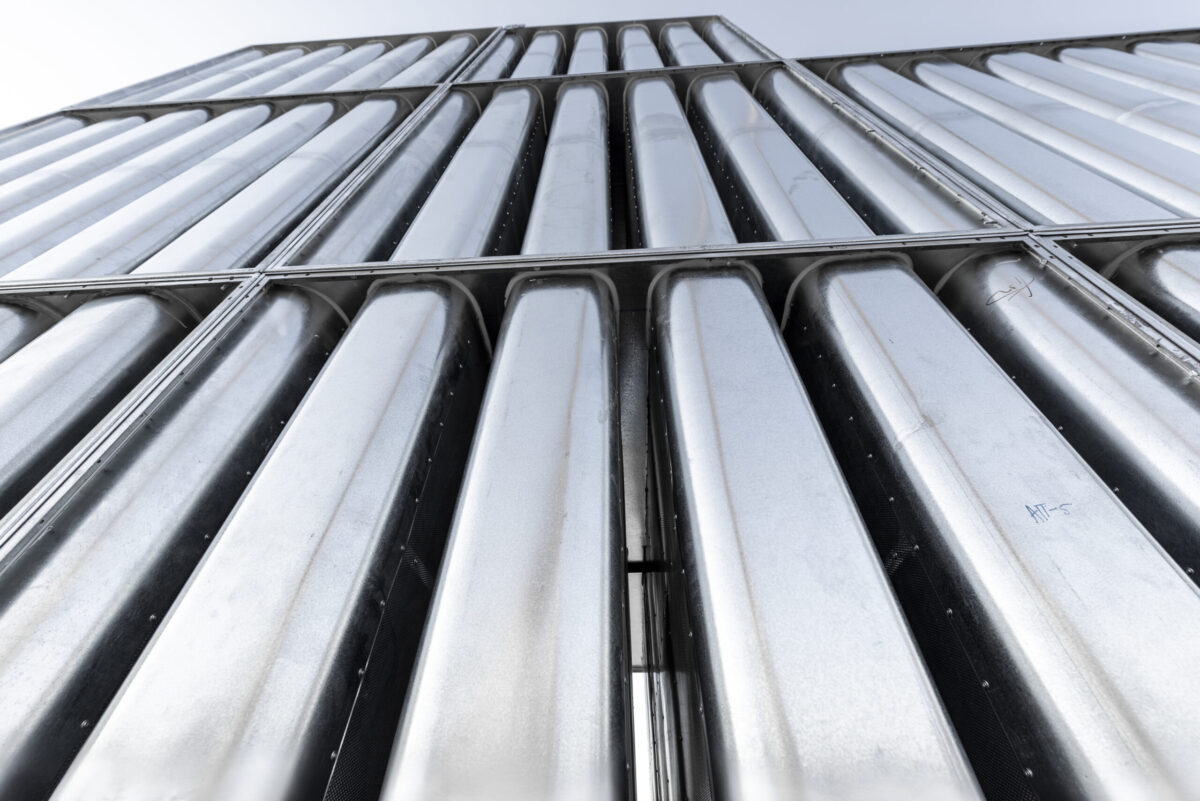
  • Aerofoil Blade Profile: The geometry physically blocks the line of sight. Sound waves cannot travel in a straight line through the opening. They are forced to navigate a “tortuous path” around the blades.
  • Perforated Underside: The casing is solid metal on top to shed water, but the bottom face is perforated to absorb the unwanted noise.
  • Acoustic Infill: Inside the blade is the secret weapon. We pack it with high-density, inert mineral wool or fibreglass to absorb acoustic energy.

The Aerodynamic Balancing Act

Here is the headache for every MEP engineer.

You can make a louvre that blocks 100% of the noise. You just make the wall solid. But then air cannot move.

In ventilation design the enemy is “pressure drop.” Every obstacle you put in the airstream makes the fans work harder. If the resistance is too high the equipment overheats. Or the fans ramp up to compensate.

That just creates more noise and burns more energy.

High-performance louvres have to thread the needle. We focus on optimizing specific aerodynamic metrics to ensure the system works:

  1. Static Pressure Drop (Pa): Keeping resistance low to minimize fan load.
  2. Face Velocity: Managing the speed of air at the intake to prevent turbulence.
  3. Regenerated Noise: Ensuring the air passing over the blades doesn’t create new noise.
  4. Water Ingress Protection: Balancing air entry with weather protection.

The aerofoil shape smooths the airflow. It keeps the air moving efficiently while the mass of the blade kills the noise.

It’s more than just for looks.

Where We Use Them

You’ll find these units wherever the building envelope is breached for airflow.

They are critical for building façades. Architects use them to mask fresh air intakes. They need to blend in visually while doing the acoustic work.

They are the standard solution for HVAC plant rooms. These rooms are noisy environments. The louvres serve as the intake walls to contain that mechanical roar.

Go up to the roof and you see them around chillers and cooling towers. Rooftop noise travels. It hits adjacent buildings. Acoustic louvres form screen walls here to block the direct path of the sound without recirculating hot air.

We also see them in industrial ventilation systems. Power generation and manufacturing plants move incredible amounts of air. They rely on louvres like these to keep environmental noise to a minimum.

The Galloway Standard

Specification integrity is the biggest risk in this market.

Not all metal louvres are created equal. If you specify a product based on generic data you are rolling the dice. “Cookie-cutter” specs often fail once the equipment turns on.

At Galloway Acoustics we approach this differently.

Take our L-AS (Single Bank) and L-AD (Double Bank) series. We build them for longevity and verify them for performance:

  • Material Construction: Available in heavy-duty galvanized steel (DX51D+Z275) or marine-grade aluminum for corrosive environments.
  • Independent Testing: Our performance data is derived from tests in strict accordance with BS EN ISO 10140-2-2021.
  • Structural Integrity: Engineered to withstand significant wind loads and environmental stress.

For an acoustic consultant this traceability is non-negotiable. You need to know that the transmission loss data is real. If the lab data is wrong your environmental noise model is wrong. That leads to complaints and expensive retrofits.

The Bottom Line

We rarely celebrate the components we cannot see. That is the nature of the job.

But the acoustic louvre is critical. It allows buildings to function. It keeps the mechanical heart of the structure beating without disturbing the peace.

It comes down to trust. You need a product that balances aerodynamics with acoustics. You need data you can rely on.

Do that right and the building functions as beautifully as it looks.

Contact the Galloway Acoustics engineering team today to discuss your next project requirements and get a custom specification for your build.

Categories
Blog

Fire-Rated Sound Attenuators : Safety and Sound Control

Whether you own commercial or industrial property, as the owner it’s your responsibility to ensure that it is not only functional, but that it is also safe and compliant with health and safety laws, rules, and regulations. 

Considering the fact that facilities of this scale often feature extensive HVAC systems consisting of metres upon metres of ductwork, it’s safe to say that they can get noisy from time to time. Because HVAC systems feature equipment such as ventilation fans, rooftop package units, and other mechanical equipment, sound travels through the ductwork. This can not only be distracting and uncomfortable, but more importantly, it can pose significant health and safety risks. 

This is why Galloway Acoustics sound attenuators are in such high demand. Sound attenuators, also known as air duct silencers, or dissipative silencers, are specially constructed tools designed to significantly reduce HVAC system noise levels, while offering a wide range of other benefits in the process. 

Here are just a few of the many benefits associated with Galloway Acoustics sound attenuators in your HVAC systems. 

Noise Reduction

One of the most prominent features of sound attenuators is their ability to significantly reduce noise levels. 

Thanks to their unique design, they feature baffles which help to disperse sound energy as air flows through them with virtually no resistance at all. As air and soundwaves make their way through the HVAC system, these attenuators disrupt and disperse the soundwaves using noise-absorbing materials, without any drops in pressure.

In simple terms, they serve as mufflers for HVAC systems and as air passes through them, they help to reduce noise generated by the systems. This not only helps to reduce noise pollution and create a more relaxed and quieter environment, it also makes the systems less distracting and prevents the risk of hearing damage. 

Dual Purpose Design for Fire Protection

As well as offering high-performance noise reduction in HVAC systems, thanks to their dual-purpose design, sound attenuators also offer a significant amount of protection against fire. 

Because of their superior construction, attenuators act as critical fire barriers in HVAC systems. Each product is fully compliant with BS 476: Part 24 (1987) standards. The purpose of which is to measure and ensure a ductwork system’s ability to not only resist fire, but resist the spread of fire throughout its system, without any loss of integrity or stability to function as a ductwork system.

In the event of a fire, both integrity and insulation are critical factors when it comes to managing a blaze and preventing its spread. This is yet another area in which these products really shine. 

Galloway Acoustics Sound Attenuators are constructed using premium-quality, industry-standard non-combustible infill, along with heavy-duty galvanised steel casings and fire-resistant sealants. This offers superior protection against not only the risk of fire, but the risk of it spreading throughout the system. 

Health and Safety

As well as offering superior protection against the risk of fire, sound attenuators in HVAC systems are also necessary in commercial settings such as plant rooms, protected escape rooms, and smoke extract systems. 

As a result of their construction and design, sound attenuators in HVAC systems are deemed essential when it comes to health and safety in the workplace. As an example, because they’re designed to operate at full capacity in the event of a fire, they play vital roles in smoke extraction systems which means they can, and have, effectively save lives. 

Galloway attenuators are subject to stringent testing and are tested to ISO 7235 in independent UKAs accredited test laboratories. This makes them safe, reliable, and fully compliant.

Also read: Acoustic Louvres: The Unsung Heroes of Architectural Noise Control

Energy Savings

Finally, for organizations looking to save both money, and energy, Galloway HVAC attenuators are ideal. 

Not only do they allow air to flow through the systems with minimal resistance, and thereby reducing the strain and workloads on electrical components like motors, fans, and cooling systems, they also improve HVAC efficiency in general.

During the summer they help to keep conditions nice and cool, whereas during the winter they help keep everything nice and warm for longer periods of time. 

When HVAC systems function efficiently, they don’t need to be used as frequently as older, outdated systems struggling to keep up with demand. This results in less energy being consumed, and lower energy bills so you’re not only doing your part for the planet, you’re also lowering your outgoings in the process.

Categories
Blog

Data Centre Noise Control: Managing Cooling Without Compromising Acoustics

Data centres are running hotter than ever.

Rack densities are climbing to support AI and high-performance cloud computing. The thermal load is skyrocketing. To keep servers from hitting thermal shutdown you need air. Massive amounts of it.

The cooling infrastructure required to move that air generates a wall of sound. You have high-static pressure fans. You have chillers. You have backup generators.

It’s more than a low rumble: server fans produce a piercing high-frequency tonal whine. It cuts right through standard building fabrics.

For operators and consultants the challenge is twofold. You must reject heat to maintain uptime. But you must also meet strict environmental noise regulations.

If you fail the BS 4142 assessment you’re headed for disaster.

At Galloway Acoustics we view noise control as a critical component of the mechanical design. It isn’t a nice-to-have. It is an operational necessity.

Here is how we engineer the silence required for high-density computing.

The Internal Airflow Challenge

The problem starts inside the air handling units.

To move the necessary volume of air fans have to run at high RPMs. This generates turbulence and blade pass noise. You cannot simply block the duct to stop the sound because “pressure drop” is the enemy of efficiency. High resistance kills your PUE rating.

We solve this with sound attenuators.

These are aerodynamic splitters installed directly into the airstream.

  • Aerodynamic Profiling: We design the “bullnose” entry and exit profiles to slice through the air rather than block it. This minimizes static pressure drop.
  • Tuned Absorption: We carefully select the gap width between splitters to target specific frequencies. We can mute that high-pitched server whine without choking the airflow.
  • Flow Management: The splitters straighten the airflow. This reduces turbulence and the “regenerated noise” that comes with it.

Securing the Building Perimeter

The building façade is the weak point. You need to pull fresh air in and exhaust hot air out from Chillers. Every opening is a potential leakage path for noise.

Standard weather louvres are useless here. They offer zero acoustic resistance.

You need acoustic louvres.

In a data centre context we typically deploy deep-bed units to handle the breakout noise.

  • Façade Integration: We install these as the architectural skin of the intake and exhaust plenums. They look like part of the building but act as a barrier.
  • The Tortuous Path: The blade geometry forces sound waves to impact the acoustic media multiple times. It strips energy from the wave before it hits the property line.
  • Visual Screening: They hide the mechanical chaos inside while providing the necessary free area for ventilation.

The Backup Power Problem

Data centres live and die by redundancy. That means massive diesel generators on standby.

When these kick in for a test, the noise levels are deafening. A standard steel door does nothing here. You need acoustic doors.

We engineer these specifically for plant rooms and generator cells.

  • High Mass: These aren’t standard fire doors. They are heavy multi-layered barriers designed to stop low-frequency engine roar.
  • Magnetic Seals: A door is only as good as its seal. We use high-compression magnetic seals to ensure there are no air gaps.
  • Threshold Performance: We pay strict attention to the bottom seal. If air can get under the door then sound can get under the door.

Rumbling on the Rooftop

Finally look at the roof. Chillers and cooling towers run 24/7. They radiate noise in all directions.

If there are residential buildings or offices nearby you have a problem.

The solution is the acoustic screen or enclosure. We build these around the equipment to create a “noise shadow.”

  • Line of Sight: If the neighbors can see the chiller they can hear it. Our screens block that direct path.
  • Barrier Effect: The solid mass of the screen reflects the sound upward away from sensitive receivers.
  • Absorption: The inner face of the screen absorbs sound. This prevents the noise from bouncing around the roof and amplifying.

Also read: Acoustic Louvres: The Unsung Heroes of Architectural Noise Control

The Galloway Approach to Compliance

When it comes to data centres there’s nothing more expensive than guesswork.

If you install a silencing system that restricts airflow you overheat the servers. If you install one that lets too much noise out you violate planning conditions.

That’s why we don’t guess. We test relentlessly.

Our product range is backed by independent data from Salford University and Sound Research Laboratories. We know exactly what the pressure drop will be at a given face velocity. We know exactly what the insertion loss is at each frequency.

The Bottom Line

Cooling is the lifeblood of a data centre. Noise is the byproduct.

You cannot have one without managing the other. By taking a multi-layered approach you guarantee operational efficiency and regulatory compliance.

Don’t let acoustics be the bottleneck in your next build.

Contact the Galloway Acoustics engineering team today to discuss your cooling strategy and get a custom quote for your project.

Categories
Blog

Experience the Silence: How Sound Attenuators Enhance HVAC Performance

HVAC systems in homes, hotels, hospitals and offices should deliver efficient, but quiet airflow for the residents. That’s because fan and duct borne noise can disrupt work, sleep, and even patient care. 

Among different solutions available to keep the noise of HVAC systems low, sound attenuators are quite popular. They can cut noise at the source, without wasting energy or pressure.

How do Sound Attenuators Work? 

A sound attenuator reduces noise that travels through ducts. Inside a sound attenuator, you can find a porous media that transforms energy into heat. These are called baffles that block direct sound paths by frequency band. 

You can measure the performance of a sound attenuator by octave band insertion loss. It will show how many decibels the attenuator could reduce upon installation.

What Design Factors Determine the Effectiveness of a Sound Attenuator? 

Before purchasing sound attenuators, you need to have a solid understanding of their designs. It will help you pick the best option for your application. Here are the most prominent design factors that impact the effectiveness of a sound attenuator. 

  • Baffle geometry and spacing 

The rectangular sound attenuators feature parallel splitters. On the other hand, cylindrical models are using aerodynamically shaped center baffles. The cylindrical models tend to offer consistent airflow patterns. 

  • Absorption material properties 

The density of fiberglass or mineral wool determine frequency absorption. Thicker baffles tend to offer excellent frequency attenuation at low frequencies 

  • Unit Length 

Longer sound attenuators can offer better insertion loss without increasing pressure drop. Hence, they are a cost effective option available for challenging applications.

What are the Common Applications of Sound Attenuators? 

Many residential and commercial properties have HVAC systems.. Here are the most common applications where sound attenuators are highly beneficial.

  • Healthcare Facilities 

Sound attenuators can be highly beneficial for healthcare facilities. You can often see them in HVAC systems linked to operating rooms, patient recovery areas and diagnostic imaging suites. They help suppress background noise, so that it doesn’t interfere with equipments or disrupt patients.

  • Commercial Office Buildings 

Conference rooms, open plan workspaces and executive areas would benefit from sound attenuators. They can suppress noise and support day to day operations.

  • Educational Institutions 

HVAC generated noise can disrupt classrooms, libraries, and testing centers. This is where sound attenuators become extremely useful.

  • Industrial Environments 

Manufacturing plants and data centers have sensitive electrical equipment. Low frequency rubles from HVAC systems can propagate through ductwork and disrupt their performance. Sound attenuators can help prevent such issues.

How Is Performance Measured on Sound Attenuators? 

Engineers assess the performance of sound attenuators using frequency specific data across octave bands from 63 Hz to 8,000 Hz. They match unit selection to the domain noise frequencies generated by the HVAC equipment. 

Air handler rumble concentrates energy below 250 Hz. However, it requires reactive chamber designs or extended length absorptive units. On the other hand, standard baffle configurations can effectively control higher frequencies. 

When picking sound attenuators, you need to take a look at fan selection and duct sizing based on your application. This will help you with achieving target noise levels while minimizing energy consumption.

Get Your Sound Attenuators from Galloway Acoustics 

As you can see, sound attenuators are extremely helpful with reducing noise generated by HVAC systems. We at Galloway Acoustics are the leaders in Mechanical Acoustics, having our manufacturing facilities based in the UAE, Saudi Arabia, Qatar and IndiaWith over 30 years of experience in the acoustics industry, Galloway has provided customised acoustics solutions to projects worldwide.

If you are looking for precision engineered noise controlling solutions such as sound attenuators, we can help. All you have to do is to get in touch with us. 

Our attenuators meet testing and certification standards  as per ISO:7235. You can get guaranteed performance for all your HVAC equipment with our sound attenuators. Get in touch with us today to get yours!

Categories
Blog

Silent Healing: The Importance of Proper Acoustic Design in Healthcare Facilities

Few individuals besides those in the acoustics and healthcare industries know that the maximum recommended background noise in hospital patient rooms should be 35 decibels during the day and 30 decibels at night as set forth by the World Health Organisation. 

However, achieving quality acoustics in healthcare facilities is one of the most technically challenging tasks. Factors such as an open-planned layout, the use of hard internal surfaces, high footfall, vulnerable patients, noisy equipment and high noise reverberation, make it an incredibly complicated task to create the perfect acoustic conditions without accounting for the need to ensure low contamination levels and the need to use specific construction materials in infection control rooms. 

Other critical aspects to take into consideration while creating an acoustic design for healthcare establishments involve ensuring speech intelligibility between staff while also maintaining patient privacy.

Besides the adverse effects of noise on patients, improper acoustics can affect communication among work personnel, often leading to medical errors. Poor acoustics also directly impacts patient satisfaction as they may hesitate to share their medical conditions, possibly leading to greater health risks while negatively affecting patients’ comfort, safety, security and overall recovery. 

Impacts of high noise levels on patients:

  1. Irritability.
  2. Sleep disruption.
  3. Decrease in oxygen saturation, elevated blood pressure, and increased heart and respiration rates among neonatal intensive care patients.
  4. Decrease in the rate of wound healing.
  5. Higher incidences of re-hospitalisation.

Impacts of high noise levels on staff:

  1. Increase in perceived work pressure, stress, and annoyance.
  2. Increased levels of fatigue.
  3. Difficulty in communication and increased propensity for work errors.
  4. Emotional exhaustion and burnout.

Due to the aforementioned challenges healthcare facilities present, there exist limited acoustic options to employ. However, in order to combat the above, the following measures can be implemented  to create optimum ambient conditions and the most suitable acoustic environment for patients, visitors and staff :

  1. Designing mechanical, plumbing and electrical systems such that they meet the latest healthcare guidelines. This may include specifying HVAC systems with quiet air handling units and fans, isolating the equipment, limiting air velocities in ducts and other considerations.
  2. Utilising attenuators with encapsulated absorption and special melinex lining as opposed to the traditional absorptive internal lining. Sound attenuators to reduce duct-borne mechanical services noise can also be used.
  3. Using acoustic walls, floor and ceiling to achieve speech privacy between undesirable adjacencies. For example, a room between an infant or adult sleep room.
  4. Treating high intrusive noise of chillers and generators through sound attenuators, louvres and acoustic panels.
  5. Providing crosstalk attenuators between rooms to maintain privacy.
  6. Hiring an acoustic consultant during the initial design stages will enable a more efficient and effective creation of an ambient acoustic environment.

To learn more about the world of acoustics and our range of distinguished acoustic solutions, stay tuned to our blog.

Author: Arsalan Arhter

Categories
Blog

Managing The Noise Control of Chiller Noise Pollution

chiller noise control solutions dubai uae

Chillers produce noise that is beyond the acceptable limit because of multiple sound sources and the tonal quality of the noise. The problem becomes worse if the chillers are located near the residential area and especially at night. In most cases, chillers are located on the ground floor or on the roof.

In both cases, the noise of the chiller can be very intrusive and can affect the residents of the building and nearby buildings. The noise of the chillers mainly comes from airflow noise from condenser fans and compressor noise during running and on/off cycle of refrigerant.

Acoustic treatment is required for rooftop and air-cooled chillers because the noise from these chillers affects the nearby occupants. This occupant annoyance could lead to code violations and subsequent financial penalties. 

The rooftop and air cooled chiller requires higher ventilation rates to circulate for their working and therefore providing the solid barrier or sound attenuator can affect the performance of the chillers.

The Acoustic louvers allow the air to circulate and also help to reduce the noise to the permissible limit in the nearby surroundings. The blades of the acoustic louvers are designed as aerofoil or semi-aerofoil to allow proper air circulation and it also protects it against weather including rain. 

The effectiveness of the acoustic louver to reduce the rooftop and air-cooled chiller’s noise depends on the depth of the louvers and their location. If the acoustic louvers have more depth it will give a better reduction of noise especially at lower frequencies.

The acoustic louvers should be located close to the chillers so that the noise diffracts around the louvers. The test standards for the measurement of sound insulation for acoustic louvers are BS EN ISO 140-3 and ASTM E 966.

The certification of the acoustic louvers is important so that the resultant noise levels can be achieved as per the proposed noise levels in the acoustic report.

Please connect with us to bring acoustic solutions to your  noise problems

Author: Arslan

Categories
Blog

Using Acoustics to Improve Workplace Safety and Productivity in Industrial Settings

Acoustics is an essential aspect of industrial settings, as it can significantly impact the safety and productivity of the workplace. One of the key areas where acoustics can be used to enhance industrial settings is through the utilisation of HVAC systems. 

acoustic sound attenuators in uae

One of the most critical aspects of HVAC systems in industrial settings is the control of noise levels. Noise pollution can be a significant source of stress and distraction for workers, resulting in decreased productivity and increased risk of accidents. By using advanced soundproofing techniques and materials, industrial engineers can reduce the transmission of noise through the HVAC system and create a quieter working environment. This can be achieved through the use of specialized ducts, mufflers, Sound Attenuators and sound-absorbing materials that are specifically designed for industrial settings.

In addition to controlling noise levels, industrial engineers can also use HVAC systems to enhance the air quality in the workplace. The COVID-19 pandemic has brought a renewed emphasis on Indoor Environmental Quality (IEQ) in industrial settings. With the increased concern for airborne transmission of the virus, improving air quality has become even more critical for the health and safety of workers. Industrial engineers are now focusing on implementing HVAC systems with improved ventilation, air filtration, and disinfection technologies to reduce the risk of viral transmission. By using high-efficiency filters and air purification systems, industrial engineers can ensure that the air in the workplace is clean and healthy, which can help to improve worker productivity and reduce the risk of accidents. Therefore, optimizing IEQ, including acoustics and HVAC systems, has become an essential aspect of industrial settings post-Covid.

Innovation is also a key aspect of using acoustics to enhance industrial settings. In recent years, there has been a growing focus on sustainability in the industrial sector, and engineers are looking for ways to reduce energy consumption and improve the environmental impact of their HVAC systems. One way to achieve this is through the use of advanced technologies, such as variable speed drives and smart controls, which can help to optimize the performance of HVAC systems and reduce energy consumption.

Another area where innovation can be used to enhance industrial settings is through the use of digital tools and analytics. By using sensors, data logging, and machine learning algorithms, industrial engineers can gain a deeper understanding of the acoustics in the workplace and make informed decisions about how to improve the design and maintenance of HVAC systems. This can help to identify problem areas, such as areas of high noise levels or poor air quality, and target them for improvement.

In conclusion, acoustics plays a crucial role in industrial settings, and the use of HVAC systems, along with certified acoustic sound attenuators and cross-talk attenuators for office areas, is a powerful tool for enhancing workplace safety and productivity.

By understanding the impact of sound on the workplace, industrial engineers can make informed decisions about designing and maintaining HVAC systems and utilizing innovative techniques to improve the sustainability of industrial settings. Incorporating advanced soundproofing techniques, air purification systems, and digital tools can help create a safer and more productive environment that benefits both workers and the environment.

Author: Shaheem
Published: Date